Anchored

how to befriend your nervous system & what it's trying to tell you
By Kara Richard, LMSW
Polyvagal Theory and the Science of Feeling Safe
“Polyvagal theory is the science of feeling safe enough to fall in love with life and take the risks of living”…
This powerful quote is from Deb Dana, author of a book called Anchored. A book that transformed understanding of my responses and coping. Even more so, this book brought awareness to the world within me. It helped me befriend and appreciate this internal communication system called the autonomic nervous system.
Falling in Love With Life: Why Internal Safety Matters
Who doesn’t want to be completely and utterly in love with the living of life? Who doesn’t want to have a body and mind ready to take on the beautiful transformative challenges and risks of being fully alive?
Nearly everyone desires this kind of life. What does it take to get there?
Internal safety. Not more money, more experience, more opportunity.
Trusting the Body: Understanding the Autonomic Nervous System
In the presence of many nervous systems in my therapeutic work, I have come to realize how little we believe in our body and mind working FOR us. How little awareness exists of this beautifully complex orchestra internally designed to protect our very existence. How so many people critique and criticize their human responses without working to understand the “why”.
Compassionate Curiosity vs. Self-Criticism
I love this quote by Carl Sagan, “The beauty of a living thing is not the atoms that go into it, but the way those atoms are put together”. Nothing coincidence, everything purposeful. If there’s one thing to remember, there is always a “why”. Your body doesn’t feel pain for no reason. Your soul doesn’t ache with grief for no reason. You are a wildly complex being who is constantly communicating with yourself, others and the world around you. You will never get to the “why” through shameful self criticism, but compassionate curiosity.
Let’s start working towards understanding. Start asking questions, and stop attacking.
Three Real-Life Nervous System Scenarios
Let me provide three very real, and possibly relatable scenarios:
I wake up rested, sit in front of the fireplace, and drink my coffee feeling nothing but gratitude and serenity in the present moment. My body is still, my mind is not racing. I can breathe deep, full breaths. I’m looking forward to the day ahead, to the possibility of beauty and connection in unexpected ways.
I get a call that my best friend was in a car crash. She was rushed to the hospital and is being evaluated by doctors. She doesn’t have family around, they’re in a different country and she needs me. Forget my work day, I need to take action and get to the hospital. I feel panic. My heart races, and my hands start tingling. The speed limit no longer applies.
It’s been three years with this diagnosis and chronic pain. Three long, slow, hopeless years. No doctor knows a cure, and my energy is drained. I barely have the strength to get out of bed. I’m alive, but I’m not living. I question my meaning and purpose, I feel defeat. My friends try to connect with me, but I don’t really care. There’s nothing left to give. My body feels tired. I am shutting down.
The Three States of the Nervous System
Three scenarios of life described. Three states of a nervous system experienced. First, a nervous system that is ready for connection with life and others. Second, a nervous system that is activated for action. Third, a nervous system that is drained of energy and ready to withdrawal.
What Is Polyvagal Theory?
Polyvagal Theory, developed by Stephen Porges, explains how the autonomic nervous system (ANS), particularly the vagus nerve, shapes our responses to the world through an evolutionary hierarchy, guiding our feelings of safety, connection, or threat to trigger defense (fight/flight/freeze) or social engagement. Deb says, “While we may think our brains are in charge, the heart of our daily experience and the way we navigate the world begins in our bodies with the autonomic nervous system. This is the place where stories emerge about who we are and how the world works, what we do and how we feel. It is our biology that shapes our experiences of safety and connection.”
I want to explain three aspects of the nervous system that I believe will transform your daily life and emotional wellbeing in beneficial (and necessary) ways: 1) the autonomic hierarchy, 2) neuroception, and 3) co-regulation.
The Autonomic Hierarchy Explained
Think of this as the building blocks of your experience, consisting of ventral vagal, sympathetic, and dorsal vagal pathways. Ventral vagal is your system of connection. Sympathetic is your system of action. Dorsal vagal is your system of shutdown. These systems function without you lifting a finger. Automatic. Each pathway working with one another, for your well-being and protection. No system is “better” than the other; each are necessary for your survival.
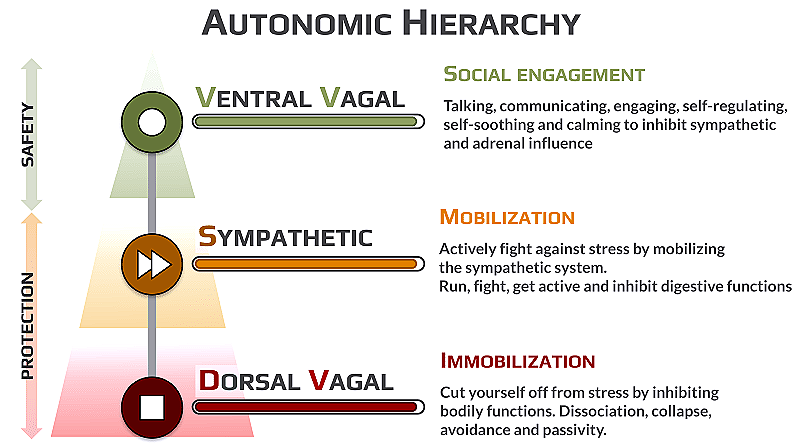
The Autonomic Hierarchy
How Beliefs Shape Nervous System States
A powerful way to grasp each pathway is by exploring the statements, “The world is…and I am…” - how am I viewing the world, and what is my place in it? These questions bring awareness to the beliefs you hold.
In ventral vagal, the world is bright, and I am hopeful. A sunny summer morning.
In sympathetic, the world is chaotic, and I am uncertain. An overstimulating bus ride.
In dorsal vagal, the world is unwelcoming, and I am exhausted. In bed on a gloomy day.
Moving Between States: Regulation and Resilience
Spend some time wondering about these three statements for yourself. Each state creates a different experience. Our reality changes dramatically as we move from one state to another. Befriending these states requires awareness. Awareness breeds understanding.
The expectation to remain in calm & connected energy all day is highly unfair, and I would encourage you to let go of this demand on yourself. We naturally travel in and out of states, and leaving regulation isn’t a problem. “The ability to flexibly move between states is a sign of well-being and resilience. It is when we are caught in dysregulation, unable to find our way back to regulation, that we feel distress” (Deb Dana).
Neuroception: Your Internal Surveillance System
Think of this as your internal surveillance system, one that is incredibly vigilant and intelligent. Stephen Porges coined this word, expressing how our nervous system (neuro) is constantly aware (ception) of signals of safety and signals of danger.
There are three streams of awareness that neuroception follows: inside listening, outside listening, and listening between.
How you think, feel, and react begins with neuroception…
Co-Regulation: Why Safe Connection Matters
Nothing gets this therapist more passionate than speaking on the importance of safe connection and co-regulation. I want to emphasize safety, because your nervous system cannot and will not regulate in the presence of an unsafe person.
Practices to Befriend Your Nervous System
Given the foundational information of polyvagal theory provided above, I want to provide practices and rhythms to actually befriend this internal intelligent guide of yours. Befriending requires understanding, but it also means to offer help and support. One of the greatest superpowers in life is the ability to offer compassionate and tailored support to your needs in times of stress and unpredictability. Stress is unavoidable, and so is the unknown. If I possess an internal system that acts as alarm/guide/intuition/protection/security, why wouldn’t I want to become familiar with it? Why wouldn’t I want to harness its knowledge of my experience? It’s not about lessening suffering or blaming everything on biology. This way of living “offers a way to be with our experiences instead of hijacked by them”. We are able to respond rather than react.
The goal? Befriend and partner with my nervous system in everyday living. Here are some of my favorite practices used in sessions and in my own life:
Bring self-compassion into a moment of dysregulation by listening to your experience. Place a hand on your heart as you repeat these phrases to yourself.
“This is a moment of suffering” or “My nervous system is in a survival response”
“Suffering is a part of life” or “Moments of protection happen for everyone”
“May I be kind to myself” or “May I bring some ventral vagal energy into this moment”
Listening from the outside in by asking the following questions:
Where am I?
What’s happening in the environment?
Who is around?
What am I doing?
What state has been achieved?
Listening from the inside out by asking the following questions:
What am I sensing in my body?
Where is energy moving?
Where is energy not moving?
Do I feel filled?
Do I feel empty?
What state is active in this moment?
Exploring the source of my response - is this response coming from the past or grounded in the present?
First, bring perception to the present moment. What cues are you getting right now? Is your neuroception one of safety or danger?
Now, ask the question, “In this moment, in this place, with this person, is this response (or intensity of response) needed? (Notice we ask if the response is needed, not if it’s appropriate)
If the answer is yes, you’re likely anchored to the present moment.
If the answer is no, look out for a familiar cue from the past that has reached out and taken hold of the present. Think about other times in your life you have felt this way.
Start incorporating the word, “yet” as an act of compassion
Yet holds a feeling of change and sense of possibility.
Ex. “I can’t be curious about the story I’m telling myself yet…” or “I’m not able to look at others without judging their behaviors yet…”
Notice glimmers, beautiful micro moments where we feel a spark of ventral vagal energy. Due to our built in negativity bias, wired to look for what is wrong, we must actively seek out, notice, and record glimmers.
When you experience a glimmer, you will likely notice it in your body. A feeling of softening around my eyes and the beginning of a smile. A thought may grab your attention or you may notice one through your senses - smell, taste, sound, the touch of something. For me, it’s noticing the way the stars shine so brightly taking a step outside my home in the country or hearing my nephew’s pure unbridled belly laugh, or feeling the sunshine warm my cheek or smelling the espresso as I walk into my favorite coffee shop.
Stretch, don’t stress
When shaping our nervous system into new patterns, the goal is to stretch, not stress our system. The quote “No gain without pain” doesn’t apply here. We must find the right degree of challenge that keeps us anchored in the present. It's an adventure - what works today might not work tomorrow. When you feel like you need to power through or suffer to see results, you will find yourself fighting or fleeing.
Discover your awe environment
Naturally, we are drawn to places we feel awe. These are places we can return to easily and predictably to find a moment of awe. It’s simple moments, in places within your reach, where you are left to ponder the magic of being alive. Look for a place in the natural world where you feel connected to something larger than yourself. Make an intention each day, “Each morning when I get up, I will walk outside and look at the stars.”
Tune in, take in, tend to
Tune in: Notice what state you are in. Tune in to the flavor of that state.
Take in: What are the cues of safety and danger you find?
Tend to: With the information you now have, what action can you take that will move you toward the safety and regulation of your ventral system or anchor you more deeply there? What does your nervous system need in this moment?
Self-care: shifting from ‘shoulds’ to recognizing need
Saying ‘should’ or ‘shouldn’t’ convey a demand on ourselves, not an invitation. These words often create shame and guilt. This word brings a message of danger and urgency, not nourishment. Start listening to the times you hear yourself saying this word…
Instead, start asking, 1) “What does my nervous system need in this moment?” and 2) “Is what I’m doing nourishing my nervous system?”
Notice how your environment influences practices of self care. Is self care embraced or dismissed? Supported or looked down upon? Challenge any messaging you received that isn’t aligned with what you need.
Finding Your Inner Invincible Summer
What would it feel like to be anchored in your life? In autonomic safety? In your internal landscape? It’s a beautiful, eye-opening journey to befriend your nervous system. To befriend the ways your body and mind are working for you. To develop a deep appreciation for this internal guide communicating with you and protecting you. You are worthy of this.
It grieves my heart to sit across from beautiful souls that have learned over time to dislike and degrade their body and mind. The person who actually is their own worst enemy. The person frustrated with the ways their body learned to protect them. Harsh inner criticism keeps you in survival mode. The body cannot heal while it is defending itself from you. The logic goes something like, “If I attack myself first, no one else can hurt me.” Your body doesn’t distinguish between danger coming from the outside world and from your own mind. Threat is threat. You can do everything right and remain stuck. If your inner world is hostile, ventral vagal will feel unattainable.
Healing requires inner safety, not perfection. The goal is shifting from attack to attunement, from attack to appreciation.
Albert Camus said, “In the middle of winter, I at last discovered that there was in me an invincible summer”.
What would it feel like to find your inner invincible summer? An internal light and warmth that is always there waiting to embrace you.
This summer is waiting to be discovered.